Jun 25, 2026
Poetic Injustice
The longer I live, the more I’m convinced that humans have minimal idea of what we’re doing. We can’t countenance this, though. We need delusion to keep going.
Driven by delusion, we try a lot of things, thankfully, and reality provides enough guardrails to channel some of the pinballs we plunge through its mazes into one hole or another.
Our actions mean revert to quasi-rational on a societal level. But individually, we’re knuckleheads. As a smart investor, you want knuckleheads in the market – just not too many of them, and not for too long.
But this is not a how-to piece on prospering as an investor. I’ll pen some deep dives soon for that crowd. Rather, it’s a short story about the dance between inner rationality and the attempt to reverse engineer it from outside manifestations.
And a story of unrequited loyalty.
I wrote last time about the irony of tribal investing in Berkshire Hathaway: A company run by the most rational investor around, yet whose followers tend to be irrational in their Buffett fandom, but otherwise more rational than most retail investors.
These fans admire Buffett’s results, and can mimic some of his process, but their inner workings are nothing like his: Buffett would never be someone else’s superfan.
They’re human and Buffett’s a mutant, but there’s positive recursion: In being irrationally passionate about (the fruits of) rational investing, these fans channel energy and capital toward a good economic cause, and their heft has enabled not just Berkshire Hathaway to prosper, but other responsible-steward-type companies, too.
None is more Berkshire-ish than Richmond, Virginia-based Markel, an insurance company often called a “Baby Berkshire” because like Berkshire, it invests its float (insurance money collected that “floats” around before accident claims get paid out), and like Berkshire, it mixes public and private holdings, and like Berkshire, it boasts a supersized annual meeting.
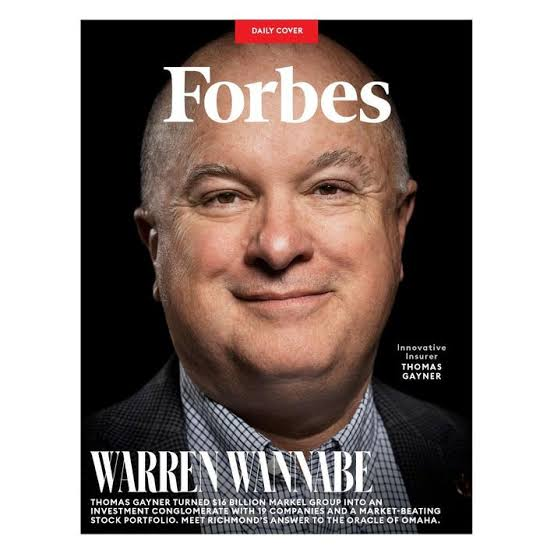
In fact, it’s run by a Berkshire fanboy: Tom Gayner, who is proud to be described as a Buffett imitator – because why wouldn’t you want to imitate the best?
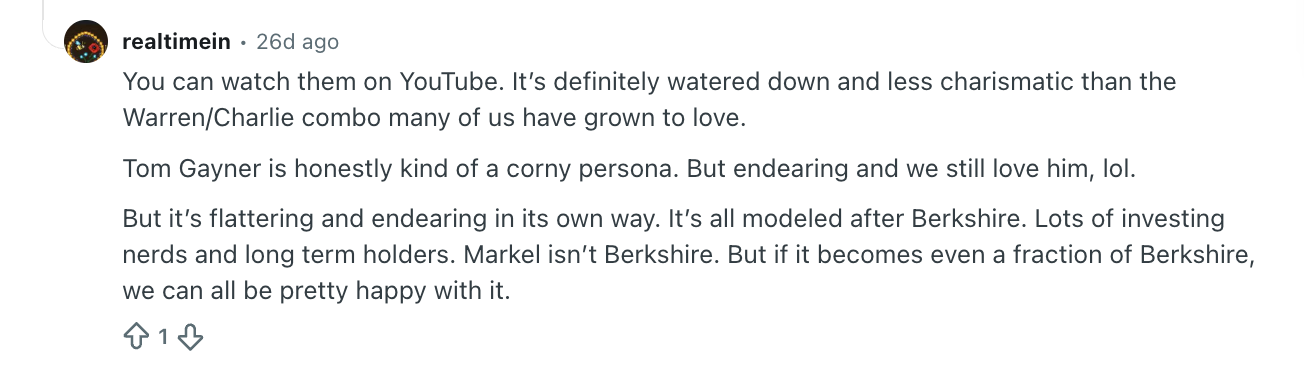
For what it’s worth, I’ve never found Tom corny.
And for what it's worth, Markel's stock has performed very well over time – but like Berkshire's, less well lately.
Left hanging by Buffett
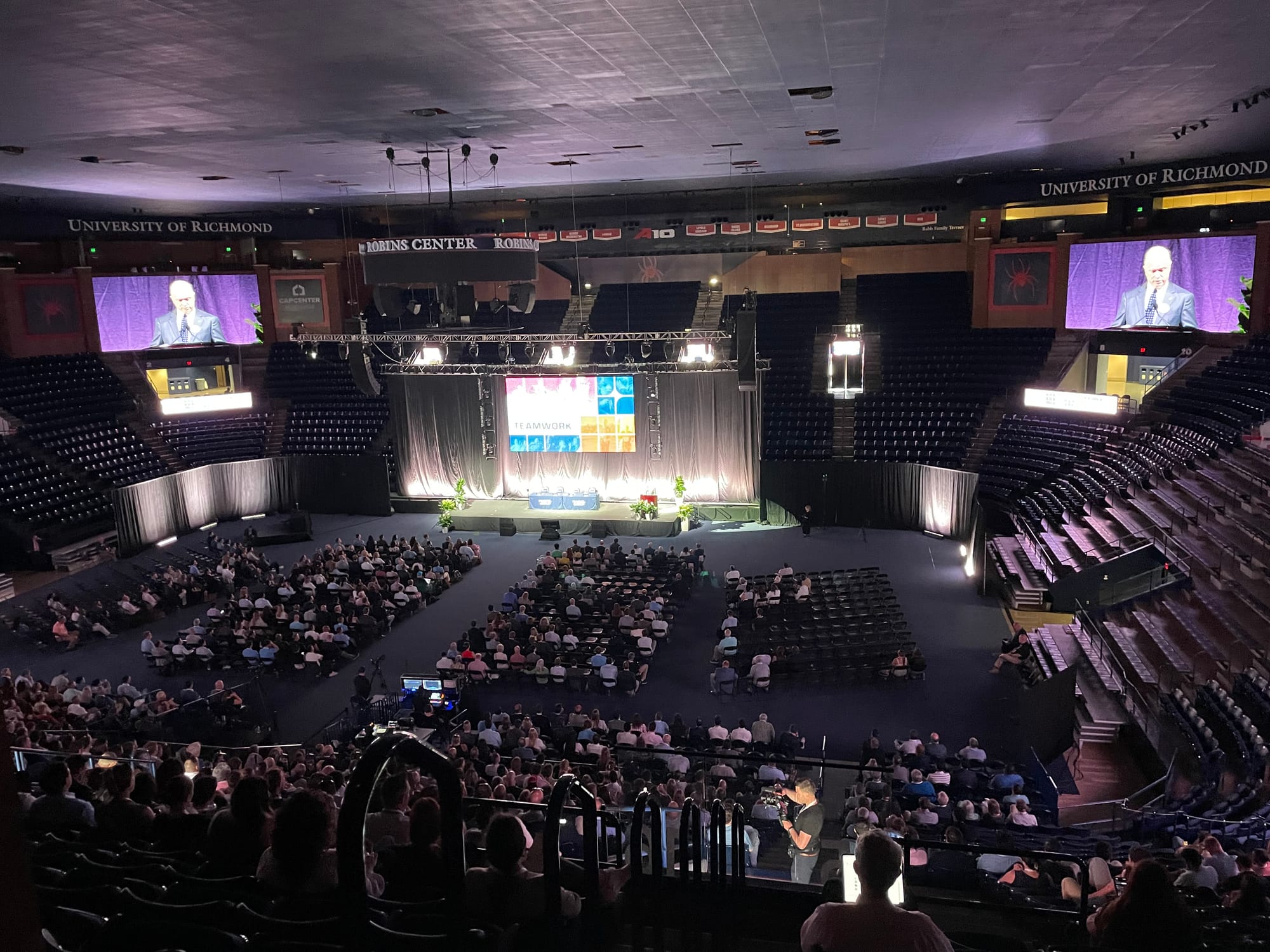
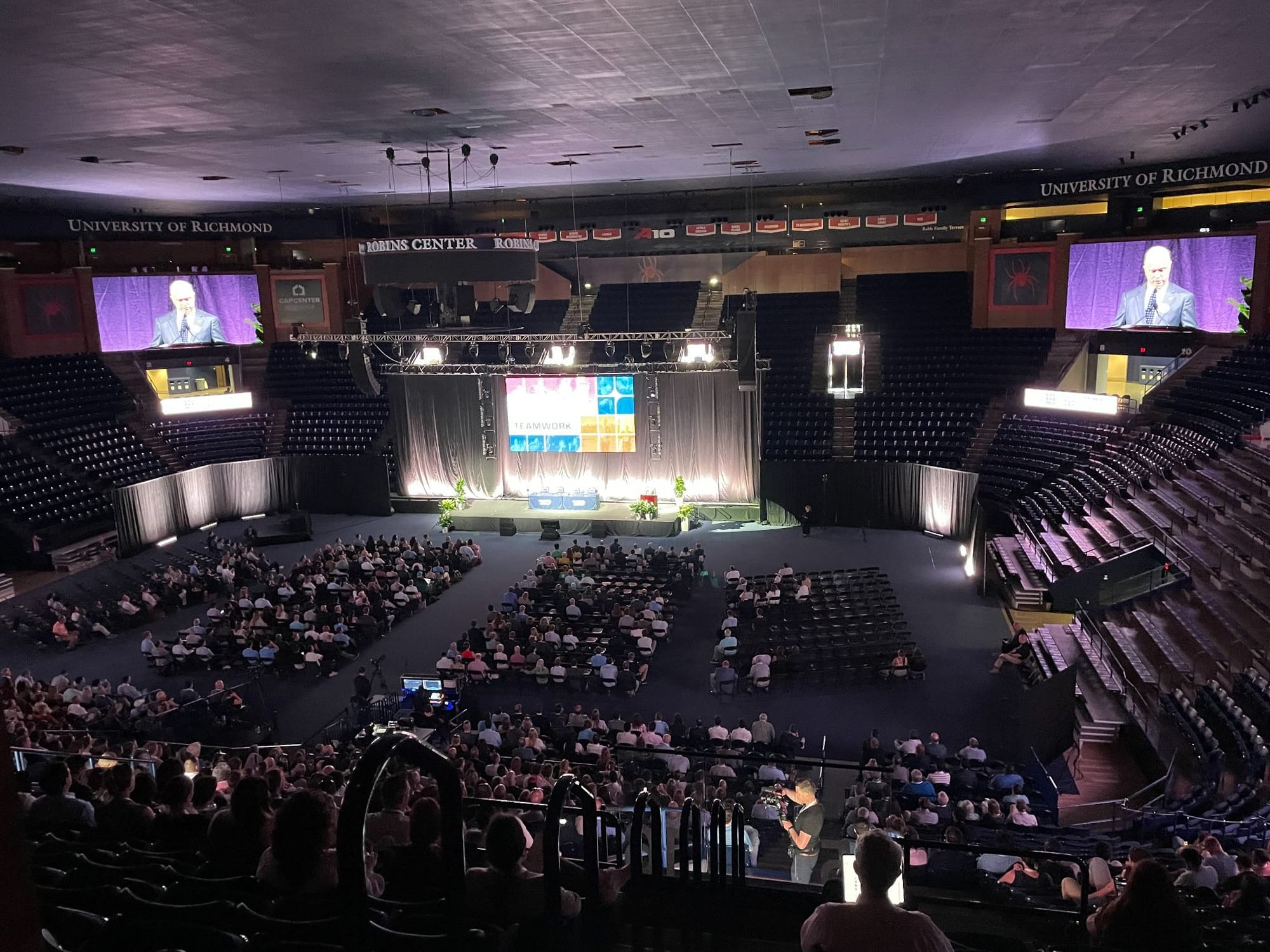
Markel – and incidentally, I’m a card-carrying member of both tribes – really leaned in to reverse engineering a shareholder tribe, in particular via a supersized annual meeting. Pound for pound, Markel’s is bigger than Berkshire’s:
It worked, at least by one measure: Tom Gayner noted in his 2025 letter to shareholders that within a large peer group – however that's defined – only Berkshire Hathaway has lower shareholder turnover than Markel.
On top of its imitation, Markel also fishes for future tribesmen and -women at the Berkshire annual meeting. Or used to.
Starting as an informal gathering in 1991, Markel’s post-Berkshire Sunday brunch in Omaha grew over three decades to several thousand attendees; the biggest, by far, of the satellite Berkshire weekend events.
The Markel-as-Berkshire-barnacle thing crescendoed with a 2022 announcement: Warren Buffett, the world’s greatest investor, bought Markel stock for Berkshire’s portfolio.
To Tom Gayner – and I’ve had the privilege of meeting and also corresponding with Tom a few times, and consider him to be among the very best human beings – it was legitimately an epitaph-level honor. Tom believes in designing a company to last for generations, and wants nothing more than owners who “get” this and are on board to build wealth over decades.
Like chocolate finally meeting peanut butter, Warren Buffett had joined the Markel tribe.
At least we thought.
But near the end of 2023, Buffett sold his Markel stock. For a long-term investor like Buffett, this dalliance was a Vegas wedding: No tribe joining, no ideological validation. Markel had been a day trade for Buffett.
While it was disappointing news, Tom was gentlemanly and non-petty about Buffett’s sale at the Markel brunch that year.
Now here’s where I extrapolate. Potentially incorrectly. Make your own judgments.
Fact 1: Markel learned that Berkshire sold its Markel stock the spring of 2024 (Berkshire sold at the end of 2023, and then had 45 days to disclose).
Fact 2: Starting in 2026, Markel discontinued its since-1991 post-Berkshire Omaha brunch.
Perhaps it was for unrelated reasons. Markel, after all, did keep its Berkshire Hathaway stock; had Markel sold its Berkshire stock after learning that Berkshire sold its Markel stock, that would have been red-handed pettiness – and that didn’t happen.
Perhaps they left a year so it would look less retaliatory, a year because they were deciding, or a year because taking over an entire conference room floor of the Omaha Marriott requires so much lead time that that was the earliest they could cancel.
Who knows what the real reason was. (Markel's professed reason was to focus more resources on its own shindig, but offering free food in Richmond, Virginia vs. in Omaha didn't channel more people to the 2026 Markel meeting this year.)
The irony is this: Despite enjoying the tribalism around him, Buffett has no interest in stepping outside of his rational investing framework – not even to throw the tribe of his corporate next of kin a bone.
(And lest anyone think this is a blot on Markel’s escutcheon: At least Buffett invested in Markel in the first place. Better to have loved and lost.)
Tribe leaders do need to have an I-don’t-need-your-approval swagger that tribe members can’t have, but is Buffett even a tribe leader – or did a tribe just pop up in admiration of his results?
You and I both know the answer.
And the answer mirrors what happens in the markets: A rare few people can keep their emotions out of their investing. Most can’t. For them, perhaps the best thing is to emulate those who can, even if that means occasionally being on the other side of their trades.