Aug 24, 2026
The Lazy Lie of Mean Reversion
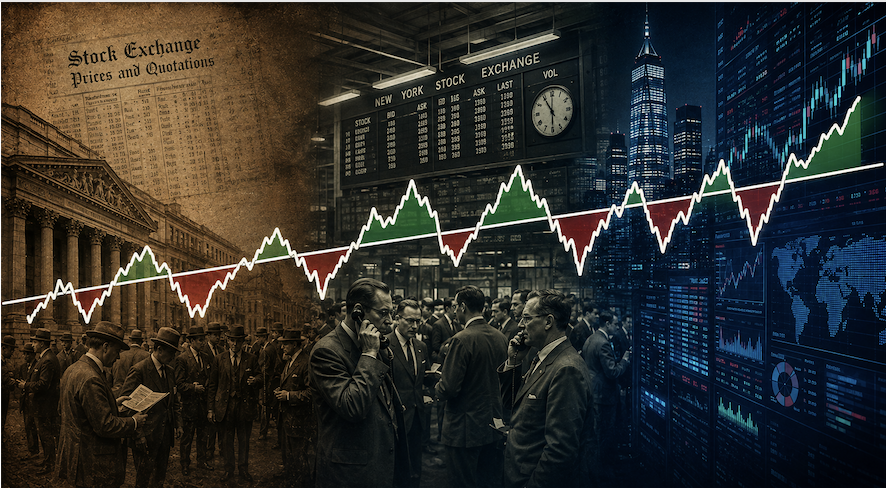
You are trusting an invisible force called mean reversion when you buy stocks because you believe the market is underpricing them.
Does it work?
Mean reversion sounds like an academic-y thing divorced from “real” investing – the fussing about EBITDA estimates, Shiller P/E ratios, and numbers porn that keeps us busy.
But it’s not. Directly or indirectly, mean reversion is the reason behind most active investing decisions.
Mean reversion, the mathematical tendency to converge on an average, is found in physical and social sciences alike. Even human happiness mean reverts: A 1978 paper – Lottery Winners and Accident Victims: Is Happiness Relative? (Brickman, Coates, Janoff-Bulman, 1978) – found that both recent lottery winners and recent paraplegics converged on average levels of happiness within months.
(According to separate research, Norwegian lottery winners are especially stoic; their happiness never even leaves the mean.)
How much do means mean to investors?
Uncertainty is an uncomfortable position. But certainty is an absurd one.
Voltaire

Mean reversion has been a theoretical and empirical battleground. The only certainties are the guardrails of common sense:
If mean reversion worked perfectly, investing wouldn’t work: If any departure from a mean – like a stock usually trading at a P/E of 15 dipping down to a P/E of 8 – were guaranteed to be quickly corrected, the departure wouldn’t happen in the first place. There’d be no window of opportunity.
If mean reversion didn’t work at all, investing wouldn’t work: If prices just bounced hither and yon, investors likewise wouldn’t be able to make any profit. There’d be no catalyst for reversion to the “correct” price.
Investors need both a window of opportunity and a catalyst for that window to close – and they need them in that order.
What is debated about mean reversion?
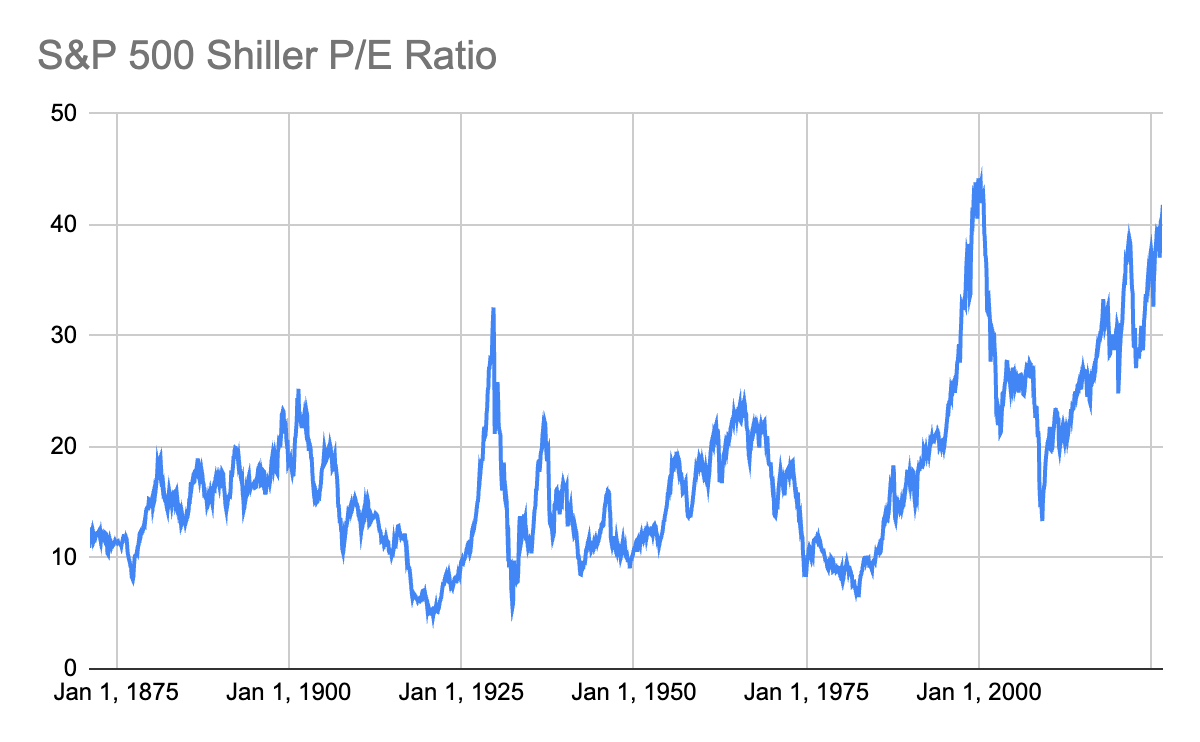
The chart above is of the Shiller Price-to-Earnings Ratio (which averages the past 10 years of earnings, adjusted for inflation), but it could be any chart for mean reversion purposes.
It’s higher than average. But is it supposed to return to its average, or not? That’s the debate.
Mean reversion can be applied to valuation multiples, to returns, and to variables inside valuation models like capital expenditures, operating margins, and tax rates. It can be applied cross sectionally – both “backwards” across a company’s own history and “sideways” across peer or industry numbers, or a mix of both.
Mean reversion is all over the place in investing.
But does it work?
“Trop de finance!” (And the most important postcard in investing)
In 1900, a French mathematics student named Louis Bachelier sought to model something Scottish botanist Robert Brown had noticed in 1827, as one of the first botanists to use a microscope: the random movement of the small particles that popped out of pollen grains in water.
Bachelier was a PhD student of Henri Poincaré, a mathematician, physicist, and public intellectual known for his eponymous conjecture as well as for fighting the Catholic Church’s anti-intellectual bent.
Bachelier was no slouch himself: He modeled Brownian motion five years before Albert Einstein used the same equations to prove atomic theory, and developed continuous time random walks four years before British mathematician Karl Pearson coined the term random walk to describe similar modeling of mosquito dispersal.

Bachelier was a genius with a flaw, at least to French academia: An interest in commerce. Not by choice, initially: Bachelier’s parents died after he finished high school, forcing young Louis to learn his father’s wine trading business to support himself and his siblings. Still, publishing a PhD dissertation on how French bond and options prices moved like pollen grain ejaculates instead of mean reverting signaled low social status to the academic elite.
“Too much finance!” mathematician Paul Lévy wrote in response to Théorie de la spéculation, Bachelier’s dissertation.
Poincaré tried to defend Louis, and Bachelier received a passing grade and got his PhD, but muddled through a mediocre academic career mostly filling in for tenured professors taking sabbaticals. His finance research sat on a bookshelf for 54 years until a mathematician named Leonard Jimmie Savage stumbled across it in the MIT library.
It wasn’t in Savage’s bailiwick, nor in his colleague Milton Friedman’s, but Savage found it interesting enough to send postcards to a few economists he thought might dig Bachelier’s 1900 dissertation, including Paul Samuelson.
Samuelson dug it – and realized that Bachelier had invented quantitative finance generations before the world was ready: Not just random walk modeling, but options pricing mathematics (Fisher Black and Myron Scholes wouldn’t publish the Black-Scholes model until 1973), plus the groundwork for Modern Portfolio Theory, the Capital Asset Pricing Model, and the Efficient Market Hypothesis.
Samuelson built on Bachelier’s work and became the first American to receive the Nobel Prize in Economic Sciences.
From oppressed idea to oppressing idea
By 1970, a refined version of Bachelier’s findings reigned supreme in academia, championed by Eugene Fama, a fitness buff known for waking at 5 a.m. and for coining the term “Efficient Market Hypothesis” in his 1970 paper: Efficient Capital Markets: a Review of Theory and Empirical Work.
Also known for harshly receiving contrary ideas, Fama, along with acolytes like Paul Samuelson, Burton Malkiel, and student Michael Jensen, established the EMH as dogma for a few decades.
Their beliefs: Efficient markets can’t be mean reverting, because a mean reversion is a correction of a pricing “mistake” – and markets don’t make mistakes. The only way to beat the market (risk-adjusted) is to get lucky or to cheat with inside information.
I believe there is no other proposition in economics which has more solid empirical evidence supporting it than the Efficient Market Hypothesis ... the Efficient Market Hypothesis is accepted as a fact of life.
Economist Michael Jensen, 1978
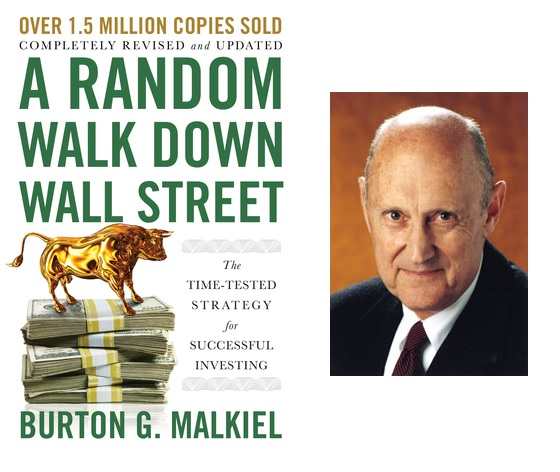
A blindfolded monkey throwing darts at a newspaper's financial pages could select a portfolio that would do just as well as one carefully selected by experts.
Burton Malkiel
Full-on EMH sounds silly to anyone who saw meme stock AMC’s stock pop after CEO Adam Aaron’s camera slipped on a livestream, revealing that he wasn’t wearing pants (the AMC “Apes” thought this was cool, and bought more stock), but to channel one of the two certainties from earlier, EMH is at least largely true, and even anti-EMHers want it to be. Otherwise, investment selection wouldn’t be rewarded by prices coming around.
The sentiment was not reciprocated. During EMH’s reign, publishing opposing papers was hard. “It’s an anomaly” was the EMH crowd’s explanation for investors, investments, or investing styles that seemed to flout their theory.
But there were a lot of anomalies.
I’d be a bum on the street with a tin cup if the markets were always efficient.
Warren Buffett
EMHers dismissed Buffett as an anomaly, too, reasoning that if enough people flip coins (coin flipping follows a random walk), somebody is going to flip a really long string of heads. Buffett, to them, was just that one-in-a-million flipper.
But by the 1980s, EMH’s explanations were getting stretched thin.
Mean reverters fight back
In 1981, Robert Shiller, of the eponymous P/E ratio, managed to publish Do Stock Prices Move Too Much to Be Justified by Subsequent Changes in Dividends? in the American Economic Review.
A standard assumption is that stocks are worth the present value of future dividends (or at least potential dividends). If a stock whose P/E is normally 15 dips down to a P/E of 8, EMHers would say the market is correctly anticipating either a lower quantity or probability of future dividends, or both.
Shiller said no: The market just plain overreacts, sometimes by as much as five times. Mean reversion was a viable investment strategy, therefore.
Shiller was so viciously attacked that he regretted publishing the paper.

But the toothpaste was out of the tube. By 2011, the American Economic Review would declare Shiller’s paper one of top 20 articles in its 100-year history.
And in 2013 – bizarrely – both Robert Shiller and Eugene Fama were awarded the Nobel Prize in Economic Sciences, despite publishing opposing research. This would be like giving someone an award for discovering that the Earth is flat while simultaneously awarding someone else for saying that it’s round. Economics is a social science.
Subsequent research bounced around, though not quite to Brownian levels.
Four years after Shiller’s firestorm, The Journal of Finance published Does the Stock Market Overreact? (De Bondt and Thaler, 1985). Their answer: Yes, prices overreact, and then mean revert. (This paper has received 14,000 citations, which in this nook of the finance literature means it’s popular with other researchers.)
In 1987, future Harvard president Larry Summers, along with James Poterba, published Mean Reversion in Stock Prices: Evidence and Implications. They took aim at Bachelier’s (and Burton Malkiel’s) random walk. Their argument: Map the possible outcomes of flipping a coin eight times – a random walk – and you’ll end with a flowchart or “tree” of nine possible outcomes. So if yearly stock returns followed a random walk, they’d have a similarly wide variance after eight years. However, the cumulative variance of yearly stock returns was only half what would be predicted under a random walk. Stock returns mean revert, this duo said.
A following paper – the not-so-subtly named Stock Market Prices Do Not Follow Random Walks (Lo and MacKinlay, 1988) – also found evidence of long-term mean reversion.
The tide had turned, and EMH in any strict sense is no longer believed to be true. Even Eugene Fama made a tacit admission of sorts in the early 1990s.
But the tide didn’t turn completely Mean Reversion in Stock Prices: A Reappraisal of the Empirical Evidence (Kim, Nelson, Startz, 1988) found that while some periods of the US market showed mean reversion, others didn’t, and on balance, stock return mean reversion was weak.
And as recently as a few years ago, Goldman Sachs looked at whether or not stocks actually mean revert on a Shiller P/E (also termed Cyclically Adjusted Price-to-Earnings, or CAPE) basis. (Aside: mean reversion of valuation multiples and of long-term returns are the most studied by researchers; they are distinct, however.) Sam Ro of Tker.co, of which I'm a paying subscriber, deserves credit for repeatedly bringing Goldman’s findings to mainstream investing circles.
Goldman’s quote: “We have not found any statistical evidence of mean reversion.”
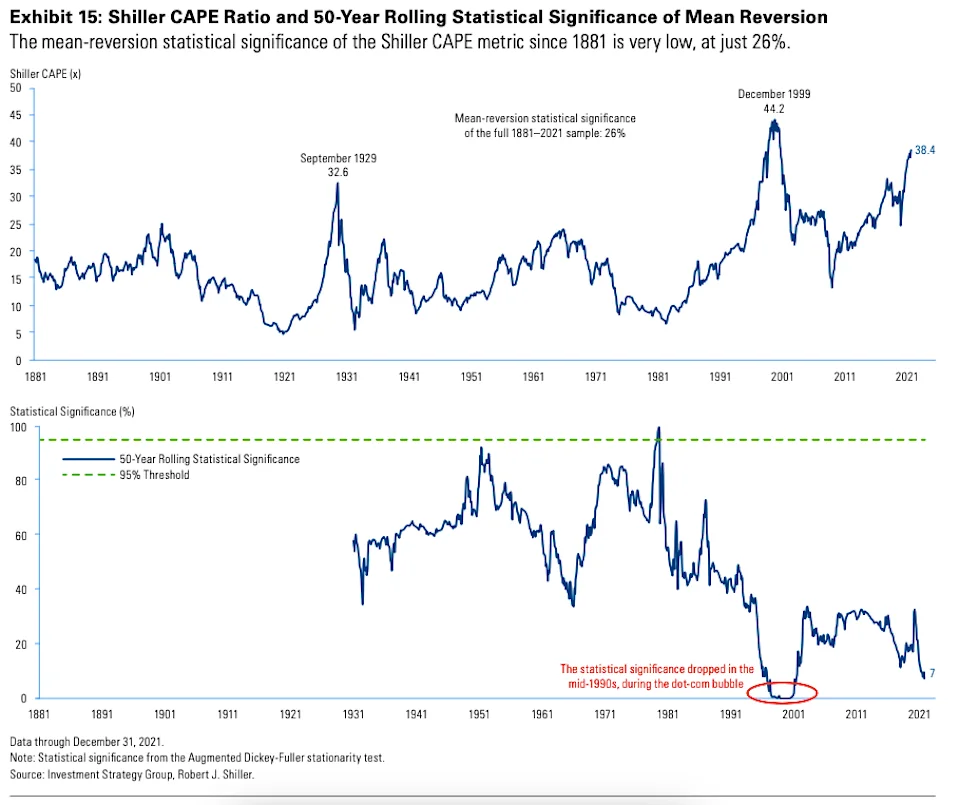
More precisely, Goldman is saying there’s a 26% confidence interval that valuations are Shiller P/E-mean-reverting, and thus 74% odds they aren’t.
From a review of the research, mean reversion in capital markets seems about as clear as mud.
That’s frustrating, but lined with a certain silver: Ambiguity is the source of investing profit.
Demanding universal clarity about mean reversion is like asking if it’s raining on Earth.
Of course it’s raining on Earth – somewhere, and in some quantity. It doesn’t always rain. And it doesn’t always not rain. Some places are rainier than others. Some seasons are rainier than others. Sometimes dry places have wet spells. Sometimes wet places have dry spells.
Similar conditionality applies to mean reversion in capital markets. At least that’s my belief.
Don’t wake me up
And in social sciences, beliefs can matter more than data. Whether mean reversion is an illusion or not, markets need to believe in it – in the right amount – to keep risk capital flowing.
To slightly rephrase our postulates from earlier:
If nobody believed mean reversion worked at all, virtually no risk capital would invest. Growth in innovation and economic prosperity would slow to a crawl.
Likewise, if everybody believed mean reversion worked perfectly, nobody would have a reason to invest outside of a broad index fund, either – leading to similar problems.
Here’s what academics tend to miss: Economics is described by numbers, but it is not governed by them. It is governed by human beings making decisions.
Regardless of the research, investors need to believe in imperfect mean reversion for markets to function. So if mean reversion is just a dream, let’s hope that it’s a dream that never ends.